Tree Trimming & Pruning in Fort Worth, TX
Targeted crown pruning, roofline clearance, deadwood removal, and ANSI A300 canopy thinning scheduled in accordance with Texas oak wilt prevention guidelines.
Professional Tree Trimming & Pruning Across Fort Worth & Tarrant County
When you need tree trimming fort worth, connecting with an experienced, well-equipped local tree care specialist ensures the job is done safely and correctly. Whether addressing hazardous limbs overhanging your roof, deadwood from severe summer droughts, or complete sectional dismantling of oversized trees, experienced local tree crews provide controlled operations, transparent pricing, and complete property cleanup.
Signs Your Tree Requires Immediate Professional Attention
Recognizing structural defects and biological failure early prevents sudden property damage and hazardous limb drops.
Heavy Limbs Scraping Roof Shingles
Branches contacting gutters, fascia, or roof surfaces wear down asphalt granules and create access bridges for squirrels and rodents.
Dense Canopy Acting as a Wind Sail
Unthinned, overgrown crowns that trap strong storm winds, dramatically increasing the risk of whole-tree uprooting.
Deadwood Hanging Over High-Traffic Zones
Dry, brittle dead branches (2 inches or larger in diameter) suspended over patios, walkways, driveways, or play areas.
Crossing and Rubbing Interior Branches
Branches grinding together in winds, stripping bark and creating open wounds where wood-boring insects and decay fungi enter.
Local Environmental Factors Driving Tree Stress in Fort Worth
- •Rapid seasonal vegetative growth during humid North Texas spring conditions requiring structural training.
- •Ice storm weight fracturing outer canopy tips while leaving jagged, unhealed limb stubs.
- •Oak wilt fungus transmission requiring precise seasonal timing for red and live oak maintenance.
- •Strict municipal code requirements for public street (14-ft) and sidewalk (8-ft) overhead vehicle clearance.
Operational Techniques & Equipment Trade-Offs
Every property in Fort Worth presents unique logistical considerations, from narrow rear alleys in North Richland Hills to wide acreage in Aledo. Independent contractors evaluate which method delivers maximum safety and efficiency:
Crown Cleaning & Deadwooding
Systematic removal of dead, dying, diseased, and broken branches throughout the canopy. Enhances tree health and safety without altering natural architecture.
Crown Thinning & Wind-Sail Reduction
Selective removal of small interior branches to improve air flow and light penetration. Crucial for wind resistance, but must be done moderately to avoid epicormic suckering.
Crown Raising & Clearance Pruning
Pruning lower branch unions to provide clearance over driveways, roofs (8–10 ft), and sidewalks. Improves utility access while preserving upper canopy mass.
Strict Ban on Tree Topping
Professional contractors reject tree topping (lopping off large canopy tops). Topping causes massive decay columns, starves root systems, and creates weakly attached watersprouts.
What a Contractor Inspects on Site
During your on-site evaluation, the responding tree care specialist conducts a rigorous physical assessment before generating your written quote:
- Species identification to verify seasonal oak wilt vulnerability before scheduling.
- Natural branch collar anatomy to avoid destructive flush cuts or stub cuts.
- Overall canopy foliage percentage to ensure no more than 20–25 percent of live foliage is removed in a single season.
- Structural balance, weight distribution, and co-dominant stem stability.
- Clearance measurements from roof planes, service drops, and municipal easements.
Ready for an On-Site Tree Evaluation?
Free to call with zero obligation. Connected directly with a local tree pro.
Call (321) 677-9055The Tree Trimming & Pruning Process: What to Expect
A transparent, step-by-step workflow from your initial telephone call to final yard raking.
Step 1: Canopy Health & Structure Assessment
Contractor inspects branch unions, deadwood volume, species timing, and roofline clearances. You agree on a clear scope (e.g., 10-ft roof clearance plus 20 percent canopy thinning).
Step 2: Drop Zone Safety & Rigging Setup
Ground crew secures an exclusion zone beneath the canopy, places protective lawn mats where equipment maneuvers, and sets up arborist climbing lines and lowering friction brakes.
Step 3: Aerial Climbing & Precision ANSI A300 Pruning
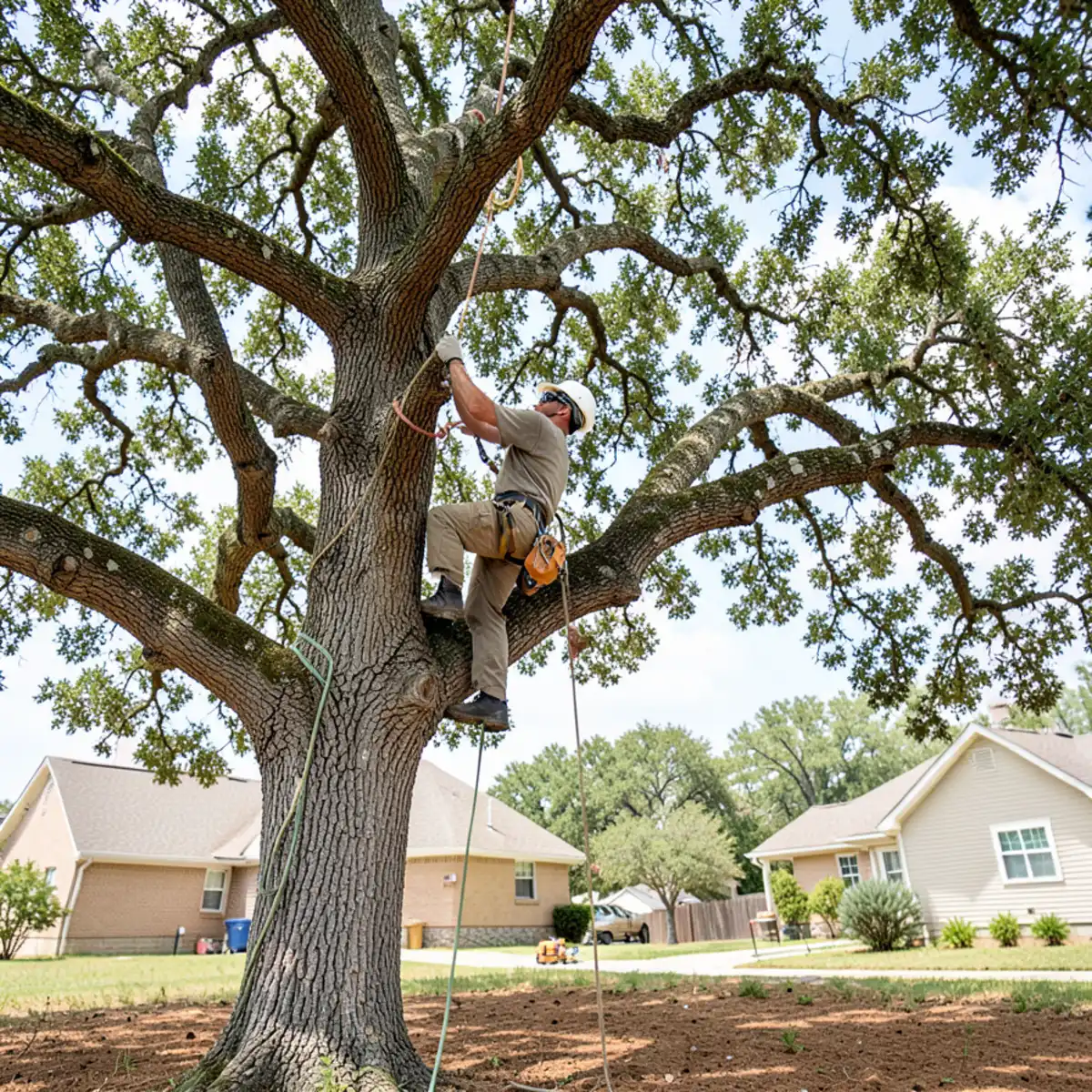
Climbers access the crown using rope and saddle or bucket trucks, cutting strictly outside the branch collar in accordance with ANSI A300 standards, never topping or stripping inner foliage.
Step 4: Immediate Wound Sealing on Oak Species
If oak species (live oak, red oak, post oak) are trimmed, all cut surfaces are immediately sealed with commercial pruning paint to block nitidulid sap beetles from spreading oak wilt.
Step 5: Chipping, Lawn Raking & Final Inspection
All pruned limbs and brush are processed through industrial wood chippers. Lawns, roofs, and driveways are raked and blown clean, followed by a final customer walk-through.
What Drives Tree Trimming & Pruning Costs in Fort Worth?
Tree service pricing is never one-size-fits-all. Published local market averages provide helpful guidance, but final costs require a physical on-site assessment.
Key Pricing Drivers
Typical Regional Price Benchmarks
Published typical local ranges for the Fort Worth / Tarrant County market. Final price determined after on-site evaluation:
Includes crepe myrtles, Japanese maples, and small fruit trees needing canopy shaping.
Typical for mature ash, cedar elms, and Bradford pears requiring roof clearance and deadwooding.
Full structural crown thinning, deadwooding, and end-weight reduction across massive spreading canopies.
Where We Dispatch Tree Trimming & Pruning Crews
Connecting property owners across our ~35-minute service radius from west Fort Worth:
Tree Trimming & Pruning in Southlake
Estate lots with mature post oaks requiring ordinance-aware pruning
Tree Trimming & Pruning in Colleyville
Wooded 1-acre residential lots with dense oak canopies
Tree Trimming & Pruning in Keller
Cross Timbers oaks requiring deadwood removal and storm clearance
Tree Trimming & Pruning in Grapevine
Historic downtown lots and lakefront oak wilt prevention
Tree Trimming & Pruning in Arlington
Aging Bradford pears needing canopy thinning and structural pruning
Tree Trimming & Pruning in Benbrook
Lakefront live oaks needing deadwood removal and wind-sail reduction
Tree Trimming & Pruning in Burleson
Mature pecans requiring canopy elevation and deadwood clearance
Tree Trimming & Pruning in North Richland Hills
Older ranch rooflines requiring 8–10 foot branch clearance
Related Tree Care Services
Related Local Research Guides
Tree Trimming & Pruning Frequently Asked Questions
Straightforward answers regarding tree trimming & pruning processes, city regulations, and estimates in Fort Worth.
When is the best time of year to trim trees in Fort Worth?
How far back should tree limbs be trimmed from my roof?
Why is tree topping bad for trees in North Texas?
Do you spray or paint tree cuts after pruning in Fort Worth?
How much foliage can safely be pruned from a tree at one time?
Request Your Free On-Site Tree Trimming & Pruning Estimate
Call (321) 677-9055 today. Connect with an independent local tree contractor serving your specific Fort Worth or Tarrant County neighborhood.